
Where the light is
A summary of the sixth chapter of You Don't Know What You're M ss ng

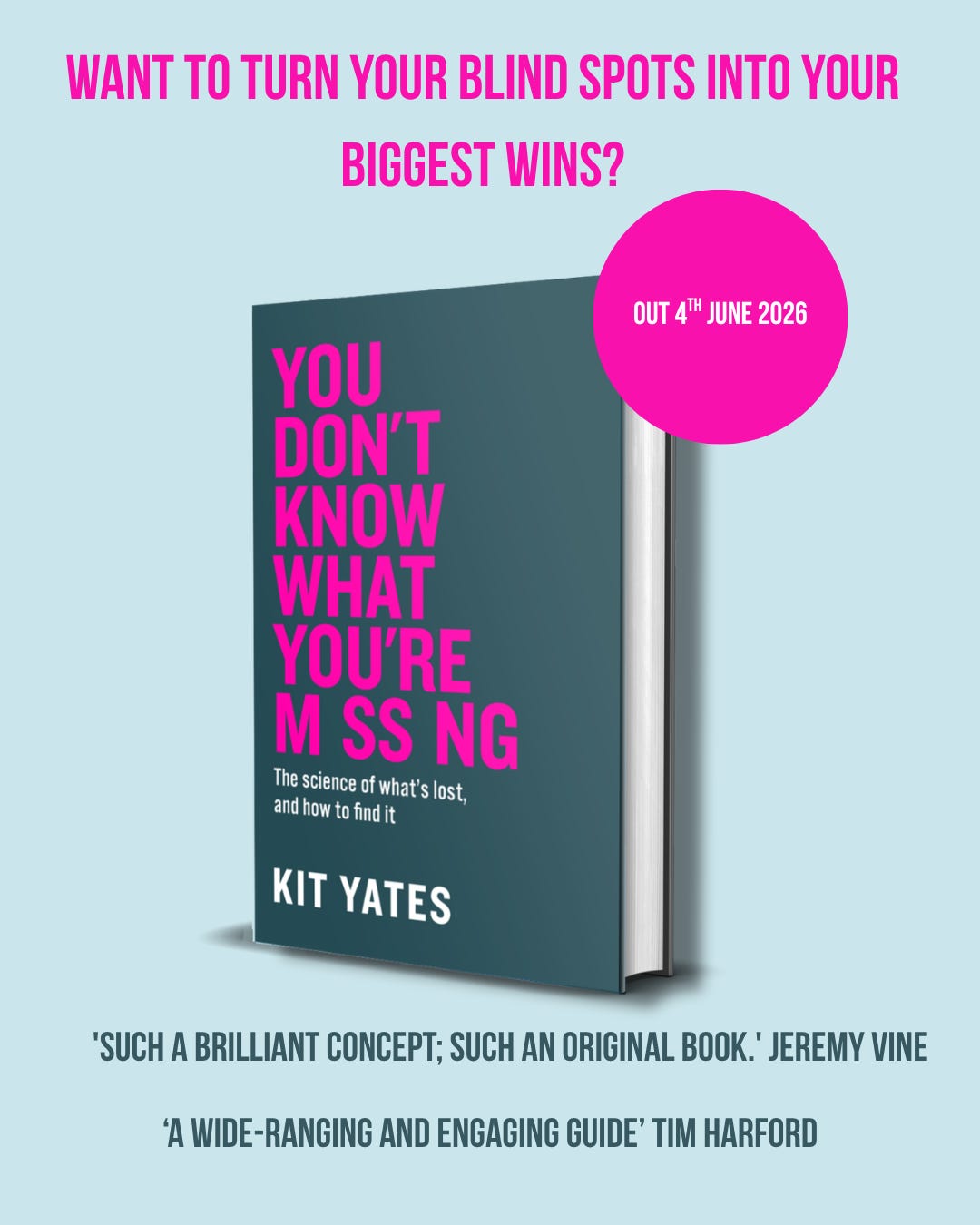
Today is the penultimate of the short series of posts I’m writing for this Substack summarising the chapters of my new book, You Don’t Know What You’re M ss ng, ahead of publication later this week (4th June). If you’ve been enjoying them, then take heart because the book is almost here. If not then take heart because this series of posts is almost over! Either way the aim is to give you a feel for the shape of the argument, the kinds of stories I use in the book to get the message across, and the ideas I hope will stick with you long after you’ve finished reading it.
In this post I’m going to summarise Chapter 6, Where the light is.
“Where the light is brightest, the shadows are deepest” - Johann Wolfgang von Goethe
One of the easiest mistakes to make when thinking about the past is to assume that what survives is somehow representative of what that era or epoch in history was like. We speak casually of “cavemen” as if our prehistoric ancestors mostly lived in caves, when in reality caves are simply the places where the evidence of their existence is most likely to have survived. Tools, bones, art and ornaments are preserved there because caves protect them from the elements. Most of the homes, objects and other traces of the people who lived out in the open have vanished. Caves are where the evidence lasted long enough for us to discover it.
That is the story of Chapter 6: Where the light is. Again and again, we focus on what survives, what is visible, what is memorable, what is measured, what is easiest to observe. And because those things are available to us, we instinctively treat them as representative. But very often they are not. They are simply where the light happens to fall.
One form this takes is survival bias. Survivors are the ones who remain visible. They are the successful people whose stories get told, the organisations that endured, the species that made it, the products that still exist. The casualties, both literal and metaphorical, are often missing from view. That is why stories of success can be so misleading. We hear from the author who persisted through rejection and became famous, but not from the many equally talented people who gave up on the twelfth rejection letter and never made their mark on the cultural tapestry. The danger is that we miss all these representative failures and build our theories of success from the winners alone.
A close cousin is the spotlight fallacy: the assumption that something highly visible is representative of the whole situation. A high-profile error can make a person seem more generally incompetent. A few widely publicised cases can make an entire group seem dangerous, unruly or untrustworthy. Media coverage can exacerbate the effect. The chapter explores the spotlight fallacy through the treatment of Liverpool and Liverpool supporters in the years before and after the Hillsborough disaster. Because football fans - and Liverpool fans in particular - had already been cast in the media spotlight as hooligans, the disaster was initially understood through that lens. Drunkenness and disorder amongst fans were blamed, even though the underlying causes were failures of crowd control, policing and infrastructure. The spotlight did not merely distort public understanding after the event through biased media coverage, it almost certainly shaped the decisions that made the disaster worse while it was unfolding.
The spotlight fallacy is one of a broader family of biases known as availability biases: what comes to mind comes to matter. If an example is vivid, shocking or easy to recall, we tend to give it disproportionate weight when making a judgement. That is why people often worry more about shark attacks than about far more likely dangers in the sea like rip currents. Shark attacks are graphic, memorable and heavily represented in popular culture. Rip currents are deadlier, but much less cinematic. Availability biases, in this context, can result in a skewed sense of risk.
And because memorable things are often the strange or unusual ones, the bias feeds on itself. The most bizarre and unusual items in a list stand out while the ordinary ones dissolve into background. In the chapter we encounter the story of a bank robber whose brightly coloured orange trainers end up giving him away because they were so memorable to witnesses. Distinctive details are easier to notice, easier to remember and easier to over-interpret. The flip side, also covered in the chapter, is hiding things in plain sight: if you want to make something go missing, one strategy is to hide it among more of the same. The best place to hide a leaf is in a forest.
Another major theme of the chapter is detection biases. Sometimes a phenomenon appears more common in one place than another not because it really is more common, but because we are looking harder there. Busy beaches report more shark sightings partly because more people are there to spot sharks. Better-policed areas can seem to have more crime because more crime is detected and recorded.
This idea becomes especially important in medicine. The chapter uses the example of incidental cancer diagnosis to show how increased scrutiny can create the appearance of a relationship where none exists. People who have had major accidents or acute illnesses can seem to have higher cancer rates simply because they are subjected to more imaging and investigation. It is not that the accident caused the cancer. It is that the accident caused the cancer to be detected.
In some cases, as with my brother-in-law, Simon, that increased scrutiny is life-saving. But detection bias also complicates how we evaluate screening programmes and treatment success. Catching a disease earlier can make survival “after diagnosis” look longer even if no extra life has actually been added. That is why we should be wary of simplistic uses of five-year survival rates when trying to sell the virtues of screening.
Then there are observer effects: the fact that measurement itself can alter the thing being measured. Sometimes this is psychological, as in the Hawthorne effect or white coat syndrome. Sometimes it is physical, as in quantum measurement, tyre-pressure gauges, code profilers, or even (in very rare circumstances) tumour biopsies that can in some circumstances alter what happens next. The act of looking is not always passive. Sometimes the very process of trying to gather information perturbs the system we want to understand.
One of my favourite ideas in the chapter, though, is the stranger subcategory of observer selection effects. These are cases where what you observe is constrained by the fact that you are only in a position to observe it under particular conditions. That is (almost tautologously) why the thing you lose is always in the last place you look: once you find it, you stop looking. It is why your friends, on average, have more friends than you do: the highly connected people are overrepresented in your experience of the network. Observer selection effects even explain why we should be cautious about marvelling at how finely tuned the universe seems for life. We can only observe a universe in which observers like us are possible.
All of this leads to the chapter’s titular metaphor. Scientists (asking the questions they can easily find the answers to and not necessarily the most relevant questions) and really, more generally, all of us, are often like the drunk searching for his keys under the streetlight. Asked whether he is sure he lost them there, he replies: “No, I lost them in the park, but this is where the light is.” We tend to study the things we can measure, count or recall, and we mistake that convenience for importance. We ask the questions to which we know we can get an answer, rather than the questions that would get us the answer.
That doesn’t mean measurement is futile, or that studying what is available is foolish. It means we have to remember that there are areas on which the light does not shine. The danger is not in looking where the light is, but in forgetting that there is darkness beyond it.
A favour: pre-order the book
If you’ve enjoyed this summary, you’ll find much more detail in the book itself, with the stories, the science, and the slightly uncomfortable implications.
If the book sounds like your sort of thing, please consider pre-ordering it. Pre-orders matter far more than most readers realise. They’re one of the strongest early signals that a book has an audience, which influences everything from how many copies are stocked to how widely it’s recommended.
Amazon: https://www.amazon.co.uk/Dont-Know-What-Youre-Missing/dp/1529438039
Bookshop.org (supports independent bookshops): https://uk.bookshop.org/p/books/you-don-t-know-what-you-re-missing-the-science-of-what-s-lost-and-how-to-find-it-kit-yates/497ab9dcf971763a