
To screen or not to screen?
Is King Charles right in his personally inspired screening call to arms?

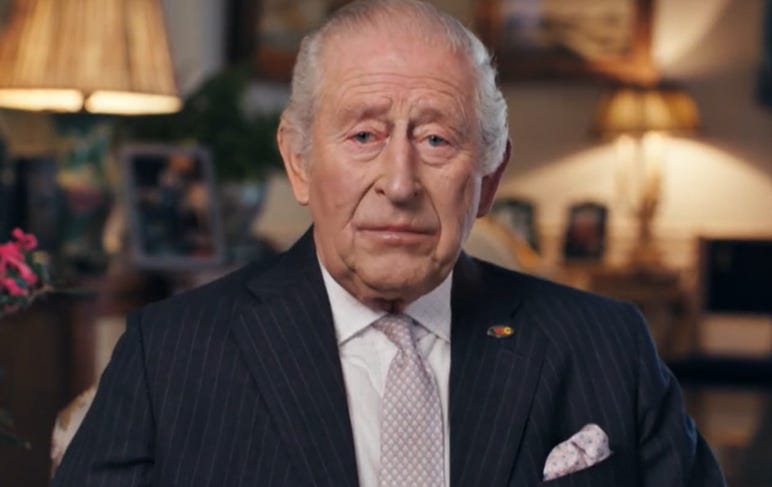
On Friday, King Charles broadcast a message to the nation about the status of his cancer treatment. He said, thanks to his “early diagnosis, effective intervention, and adherence to doctors’ orders”, his ‘schedule of treatment’ would be reduced in the new year. He urged others to take up offers of cancer screening, saying “early diagnosis quite simply saves lives.”
And he’s not wrong. Earlier detection through screening saves lives by shifting diagnosis to pre‑disease or earlier, more treatable stages. This has been shown, over and over again, to lower cause‑specific mortality in both clinical trials and more broadly in national programmes. In lung cancer, three rounds of low‑dose CT in the National Lung Screening Trial cut lung cancer deaths by about 20%, and the European NELSON trial showed roughly a 25% reduction - clear evidence that screening reduces mortality in high‑risk smokers.
Cervical screening has cut incidence and mortality dramatically: regular Pap testing reduces cervical cancer mortality by at least 80%. Breast‑screening programmes are associated with substantial mortality reductions, with meta‑analyses reporting ~22% lower risk among those invited and ~33% among people who actually attend. Contemporary cohort data show a 41% reduction in fatal breast cancers within 10 years for participants.
So why then, just two weeks before the King’s message, did the UK National Screening Committee (UKNSC) announce that it would advise the government against rolling out a routine prostate cancer screening programme targeted at all men?
Instead it recommended targeted screening every two years for men aged between 45 and 61 with confirmed BRCA1 or BRCA2 gene mutations (which, in women, are associate with increased risk of hereditary breast and ovarian cancer). Only around 0.3% of men have such a mutation and even fewer will be in the eligible age category.
Why, if we know screening saves lives, are we not rolling out screening programmes for the most common diseases left, right and centre?
Part of the answer is economic. Researchers at the Sheffield School of Medicine and Population Health, who carried out cost-effectiveness modelling for the UKNSC, found that repeated, whole-population screening was the least cost-effective option they considered. By contrast they found that targeting higher-risk groups, such as those with a known cancer-associated mutation, was far more cost-effective.
Another part of the answer lies in the accuracy of the test. The prostate-specific antigen test, which is the standard blood test used for early detection, is not accurate enough for screening a whole population. When testing a huge number of individuals who do not have the disease (as you are bound to do when conducting a population-wide screen), if your test lacks even a little specificity (meaning it gives false-positive results some of the time) then the number of false positives can dramatically outnumber the number of true positives. As I wrote about when I research breast cancer screening programmes in The Maths of Life and Death, high rates of false positives can have damaging psychological effects and lead patients to delay or cancel future screens.
However, the problems with screening go beyond simple false positives. Writing in the British Medical Journal, Muir Gray, former director of the UK National Screening Programme, admitted: “All screening programmes do harm; some do good as well, and, of these, some do more good than harm at reasonable cost.”
In particular, screening can lead to the phenomenon of overdiagnosis. Although more cancers are detected through screening, many of these are so small or slow-growing that they would never be a threat to a person’s health, causing no problems if left undetected. Nevertheless, the C-word induces such mortal fear in most people that many will, often on medical advice, undergo painful treatment or invasive surgery unnecessarily.
This is a particular problem for the PSA test for prostate cancer. It can fail to distinguish between cancers that would go on to cause serious illness and benign conditions (like benign prostatic hyperplasia – an enlargement of the prostate) that would not cause serious health issues if left undiagnosed and untreated.
Indeed, part of the reason whole‑population screening for prostate cancer is not cost‑effective is the high cost of follow‑up diagnostic tests and treatments in these overdiagnosed cases.
Similar debates around specific targeting surround other mass screening programmes, including the smear test for cervical cancer and screens for lung cancer, but this doesn’t mean the King is wrong in his call for people to attend the cancer screening available to them.
He points out that around 9 million people in the UK have not taken up at least one of the screens available to them. “That is at least nine million opportunities for early diagnosis being missed,” he said.
Screening programmes in the UK are typically targeted at people who are at higher risk of the disease. While this doesn’t completely eliminate the problems of overdiagnosis and false positives, it does reduce them in comparison with population-level screening.
So if that’s you, one of the nine million people who have been invited to a screening because you are at elevated risk, but have yet to take up the offer, do think hard about whether now is the right time to book that appointment.
Brilliant breakdown of this screening paradox. The overdiagnosis piece really changed how I think aboutit since my dad went through unnecessary prostate biopsies that turned out benign. Risk stratification seems like the smart middle ground here, but I dunno if most people understand theyre not actually "high risk" just because they hit a certain age. Population-wide screening sounds good in theory until you look at the actual cost-benefit data.
Excellent explanation, thank you.