
Putting things in context
A summary of the second chapter of You Don't Know What You're M ss ng

“We don’t see things as they are. We see them as we are.” - Anaïs Nin
If you’ve been reading this substack over the last few weeks you’ll know that I’m writing a series of posts summarising the chapters of my new book, You Don’t Know What You’re M ss ng, ahead of publication on 4th June. The aim is to give you a feel for the shape of the argument, the kinds of stories I use in the book to get the message across, and the ideas I hope will stick with you long after you’ve finished reading it.
In this post I’m going to summarise Chapter 2, Putting things in context.
On the face of it, the story that opens this chapter feels like just a fun anecdote. Eddie Vedder, frontman of Pearl Jam, steps out on the street after a Chicago Cubs game, hears a band busking, and ends up playing some of his most famous songs with them. A world-famous musician, playing some of his best-known songs, right outside a stadium that had hosted Pearl Jam a year earlier. And hardly anyone notices.
Paul McCartney once did something similar outside Leicester Square tube station, playing Yesterday for spare change as part of a film shoot. A globally recognisable artist singing an iconic song in a busy public place. And again: almost no-one stops to listen.
It’s tempting to think this is about distraction, or maybe the death of our attention spans, or just the sheer pace of modern life. And those things might be part of the story, but the more revealing explanation is simpler and more general. It’s about context. If you’re leaving a stadium after a game, or rushing through a crowded station, you’re not in “spot a global superstar” mode. You’re in “get home” mode. The context of a situation shapes your expectations, and your expectations shape what you experience. Out of context, even something extraordinary can go missing.
That idea - context as a guiding determinant of perception - runs throughout the rest of the chapter.
A good way to understand the impact of the surrounding context is to look at what happens when something genuinely is missing from your sensory input. You’re probably aware that you have a physiological blind spot: a small region of the retina where there are no light-detecting photoreceptors because that’s where the optic nerve exits the eye. In daily life you don’t notice it, partly because you have two eyes and your brain blends their images together. But when you test it with one eye (see below), the striking thing is not that you get a hole in your vision. You don’t. The object you’re looking at disappears and the brain simply fills in the gap with whatever pattern it thinks should be there. White background produces white. Black background produces black. The missingness is plastered over.
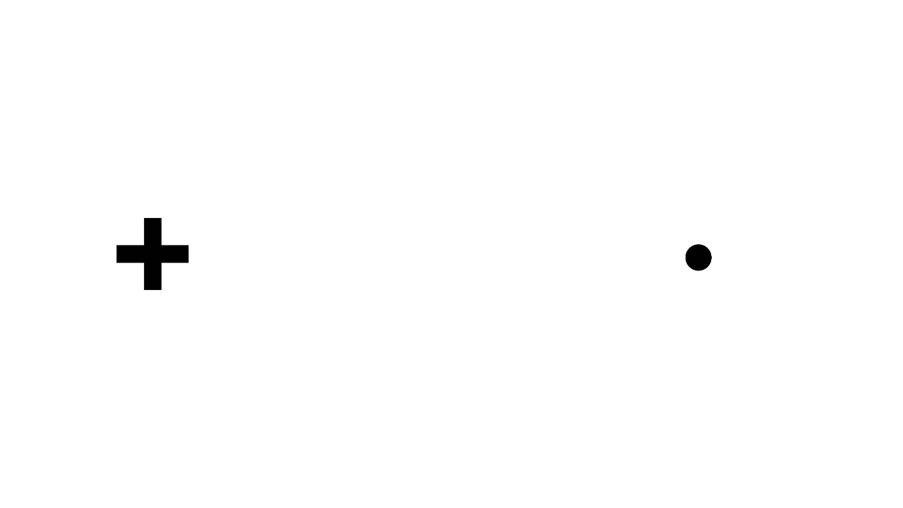
Position the screen about 35cm from your face (or between three and four times the distance between the cross and the dot if that is markedly different on your device. You might have to experiment with this positioning. Cover your left eye so you can’t see out of it at all. Line up your right eye with the cross on the left hand side of the page and focus on it. You may need to adjust the distance at which you hold the book slightly, but you will find a relatively large range of distances for which the black spot on the right hand side disappears. What remains, however, is not a hole in our field of vision. Instead the brain has filled in the gap with white, the colour of the background surrounding the black dot.
The same basic thing happens in time as well as space. Your eyes make rapid saccadic jumps as they scan the world, but the in-between bits are not delivered to your conscious experience as a blur or a flicker. Instead, your brain down-regulates your visual input for the movement and fills the gap with the stable image after the movement has finished. This is known as saccadic masking. The result is that you feel like you saw the scene continuously, even though you didn’t. You can experience this happening in practice as part of the stopped-clock illusion: moving your eyes to focus on a clock face, the first “second” can feel strangely long, as if time has briefly frozen and then restarted – consistent with the visual system filling in the gap during which your eyes moved with the image input at the end of the movement.
Once you are aware of these effects, you start to understand why the phrase “Sorry Mate, I Didn’t See You”, often heard after traffic accidents, is not always a confession of carelessness. It can be a description of a real perceptual mechanism. When we pull out of junctions we often feel as if we’ve checked the whole panorama, but what we may actually have is a small set of snapshots stitched together, with the missing bits smoothed over. The stitching is normally a blessing. In the wrong place, at the wrong time, though, it can be disastrous.
That brings us to one of the most unsettling ideas in the chapter: the illusion of absence. This is not just failing to see something because it was behind an obstruction. It’s the stronger, more dangerous belief that the obstructed region is empty. Not “I couldn’t see what was there”, but “I effectively experienced it as not being there at all”.
Driving is full of opportunities for this sort of mistake, because cars come with built-in occluders: pillars, headrests, passengers, windscreen stickers, mirrors that don’t quite show everything. The A-pillars of modern cars are particularly pernicious. They don’t need to be large to hide something important, and under certain conditions another road user can remain hidden behind a pillar for long enough that by the time they emerge into view there’s no time left to do anything useful.
We all know that blind spots exist. But perhaps what is harder to understand is that a driver can genuinely feel they have checked, genuinely feel the road is clear, and still have been wrong - because their brain has treated the occluded region as “seen and empty”, rather than “unseen and unknown”.
For a more general psychological handle on why this happens, we explore a phenomenon called amodal completion: our propensity to fill in gaps when objects are partially occluded. We do it all the time. In many cases it’s incredibly useful. A scene full of partial information becomes coherent because the brain completes it. The problem is that the same mechanism can also suppress alternative possibilities. Once the brain has completed a scene in one plausible way, it can be surprisingly hard to hold in mind what else might be behind the occluder.
The chapter then widens from occlusion to a broader class of context effects: situations where the same physical stimulus can be experienced in dramatically different ways depending on what your brain assumes about the surrounding conditions.
The classic visual example is light constancy. In the real world, your brain tries to keep the perceived lightness of surfaces relatively stable even as illumination changes. Normally we would regard that as a triumph of perception. But it also means that ambiguous lighting can produce wildly different interpretations of the same image. The Dress is the famous case: people genuinely saw The Dress in different colours because their brains made different assumptions about the illumination, and then corrected for it. The assumed context of the image was vital to how The Dress was perceived.
And although many of the examples in the book are visual, our other senses employ context to help them out as well. For example, it turns out that, labels matter for smell and names matter for taste. If you tell someone a pine-like odour is “Christmas tree” they don’t just enjoy it more than if you call it “disinfectant” - many people seem to experience it as a different smell altogether. Likewise, taste can be influenced by expectation: what you think you’re about to taste can change the taste you actually experience.
Hearing perhaps even more vulnerable to these context-dependent overwritings. The internet has produced some wonderfully compelling illustrations, like the Brainstorm/green needle clip, where the same ambiguous sound can flip depending on what you’re primed to hear. If you hear the stimulus thinking about one phrase, then this is probably what you’ll hear. But if you prime yourself by thinking about the other, then that’s what you’ll hear. Your expectations don’t merely bias a judgement after the fact. They shape the perception itself.
Although many of the stories in the chapter emphasises the places where context can mislead us to fill in the gaps incorrectly, there’s also a more useful side to context-aided perception. Cochlear implants can initially sound fuzzy and distorted to new users, and yet with time many people report that their perception adjusts. The brain reroutes in order to fill in the gaps using the context it previously learned. The same top-down machinery that can mislead us can also help us adapt, sometimes in ways that feel close to miraculous.
All of these phenomena sit under a broader umbrella of top-down processing: the brain starting with higher-level frameworks - memories, expectations, assumptions - and applying them to make sense of lower-level sensory inputs. It’s a key driver of what I call intrinsic missingness. It helps us cope with ambiguity and incomplete information.
Once you accept that expectations can change perception at this level, it becomes easier to believe that disagreements about the world are not always about one person being irrational or dishonest. Two people can be looking at the same thing and genuinely experiencing it differently, because they are bringing different contexts and different life histories to the scene. That doesn’t mean “everyone’s right”. But it does mean we should sometimes be a little less certain that our own interpretation is the only reasonable one, and a little more willing to ask: is there something missing here?
A favour: pre-order the book
If you’ve enjoyed this summary, you’ll find much more detail in the book itself, with the stories, the science and the slightly uncomfortable implications.
If the book sounds like your sort of thing, please consider pre-ordering it. Pre-orders matter far more than most readers realise. They’re one of the strongest early signals that a book has an audience, which influences everything from how many copies are stocked to how widely it’s recommended.
Amazon: https://www.amazon.co.uk/Dont-Know-What-Youre-Missing/dp/1529438039
Bookshop.org (supports independent bookshops): https://uk.bookshop.org/p/books/you-don-t-know-what-you-re-missing-the-science-of-what-s-lost-and-how-to-find-it-kit-yates/497ab9dcf971763a
Thanks,
Kit
Two people can look at the same situation and come away with completely different meanings.
Not because everyone’s right, but because we all carry different histories and contexts.👏 @http://kityates.bsky.social
💯 Stay curious, not certain, and ask: what might I be missing?
https://kityates.substack.com/p/putting-things-in-context?r=cwb8u&utm_campaign=post&utm_medium=email