
Presenter's Friend: Monkeys, Mathematicians and Machines
From primate geometry to AI breakthroughs, a week that challenged assumptions about human intelligence.

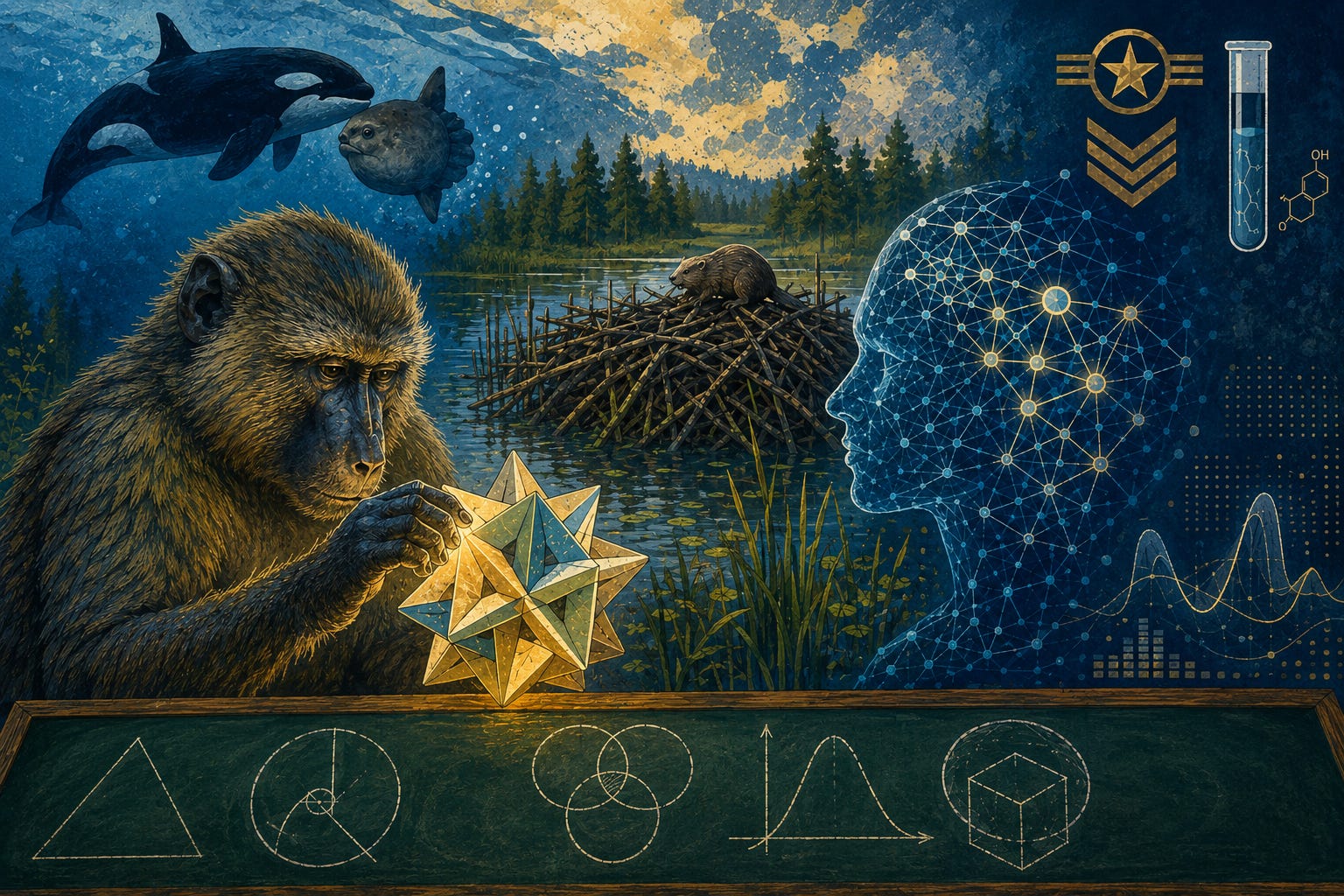
Every six weeks or so I am invited along to appear up on Radio 4’s Inside Science as the “presenter’s friend”, bringing along a couple of stories that have caught my eye and reacting to some of the other science news of the week. I’ve decided to write up some of this week’s stories into a substack post so you can enjoy them even if you missed the show. This week’s appearance turned into something of a mathematical extravaganza, featuring monkeys that can do maths and machines that can do maths too.
The first story concerned what may turn out to be one of the most remarkable examples yet of AI-assisted mathematics. In the early hours of Monday morning, just after the World Cup final had finished, the mathematician Levent Alpöge posted a tweet that immediately caught the attention of the mathematical world. It began:
“hello there the Jacobian conjecture is false thanx to my close friend Akhil for asking about it and my other close friend fable for working during the world cup final”
Alpöge is a junior fellow at Harvard and also works with Anthropic, whose AI model Claude Fable 5 is presumably the “close friend fable” mentioned in the post. The extraordinary thing was that, in the remaining 216 characters, he appeared to give a counterexample to the Jacobian Conjecture - an 87-year-old problem regarded as one of the most important open questions in mathematics.
The Jacobian Conjecture dates back to 1939 and appeared on Stephen Smale’s famous list of 18 major mathematical challenges for the 21st century. For decades, mathematicians had been trying to prove it true. But now it seems Alpöge has found a simple example showing it was false all along. It’s genuine mathematical mic-drop moment.
Explaining the conjecture without descending into deep mathematics is tricky, but the basic idea is this. Imagine a map covered with coordinates. You apply a polynomial transformation - a formula that shifts every point around using only addition, subtraction and multiplication. Provided the transformation doesn’t locally crush or flatten space, the conjecture asked whether there must always be another polynomial transformation capable of reversing the process and restoring every point to its original position.
What Alpoge effectively did was to demonstrate that there was a function which sent three separate points to the same place, so there would be no way of undoing that function and sending the one point back to three separate points. He effectively found a counter example which is super easy to check.
The big question now is how this result was produced. Neither Alpöge nor Anthropic seem to have said much publicly about the process, leaving mathematicians to speculate. Did the AI generate a genuinely deep new insight? Or did it help uncover something that was already within reach? Either way, it appears to be a dramatic breakthrough, and perhaps a glimpse of how mathematical research may change in the years ahead.
My second story was another challenge to human exceptionalism. A new study in Proceedings of the National Academy of Sciences (PNAS) explored the origins of geometric intuition and suggests that our understanding of shapes may not be as uniquely human as many researchers previously believed.
For years, some cognitive scientists have argued that humans possess an internal, inherent “language of geometry”, representing shapes using ideas such as symmetry, parallel lines and angles in a uniquely symbolic way. Under that view, recognising a square involves something like mentally checking off a list of geometric properties – two sets of parallel lines, four right angles, all sides the same length.
Researchers from Carnegie Mellon University and collaborators decided to put that idea to the test. They compared olive baboons, rhesus macaques and human preschool children. The children were included because they provide a picture of geometric reasoning before years of formal mathematics education have had their influence.
Participants were shown a shape such as a triangle or square and then asked to identify the matching shape from a set of options on the next screen. The shape might be resized or rotated (but if it started as a square then it was still a square on the next screen), so participants had to recognise the geometry rather than rely on a straightforward visual match.
The monkeys turned out to be surprisingly good at the task. Indeed, they often performed as well as, or better than, the preschool children. The researchers conclude that the foundations of geometric intuition may be shared across primates rather than representing a uniquely human cognitive leap.
The study suggests that what we think of as sophisticated human geometric reasoning may be an enhanced version of an ancestral primate ability rather than a wholly distinct symbolic system, suggesting that we’re not quite as special as we thought we were.
Away from my own stories, there were several other fascinating items discussed on the programme.
Testing testosterone
We talked about proposals from US Defence Secretary Pete Hegseth to introduce testosterone testing for American troops. There is a temptation to think of testosterone as some all-conquering force of nature, capable of explaining strength, resilience and performance. The reality is much more complicated. Most medical organisations do not recommend blanket screening of otherwise healthy adults. Diagnosis of low testosterone typically depends on both symptoms and repeated laboratory tests, not a single measurement. A solitary low result is not automatic evidence of disease or impaired performance. Treatments also carry risks, including infertility, acne, elevated red blood cell counts and increased clotting risk.
We also heard about beavers and their continued reintroduction to British landscapes. I love stories like this because they represent genuine win-win conservation. Reintroducing a formerly locally extinct native species helps protect the animal itself while simultaneously delivering wider environmental benefits. Beaver dams slow water flow and reduce downstream flooding risk. They improve water quality by filtering sediments and pollutants, and the habitats they create support an astonishing range of wildlife. It’s a lovely example of ecological restoration delivering practical benefits for people as well as nature.
Finally, we discussed the extraordinary footage of an orca ramming a sunfish so hard that it explodes. The video is astonishing and offers a reminder that animal behaviour can be every bit as surprising as anything we observe in humans. Fascinating though it is, the footage is also rather graphic, so consider yourself warned before searching it out.
Whether it’s AI challenging our assumptions about mathematical creativity, monkeys challenging our assumptions about geometry, or beavers improving ecosystems through behaviours evolved over millennia, science continues to remind us that intelligence, ingenuity and problem-solving come in many forms.
You can listen to the whole episode here: https://www.bbc.co.uk/programmes/w3ct977x