
Chess on Wheels
Why cyclists keep making breaks, even though they know they are destined to fail

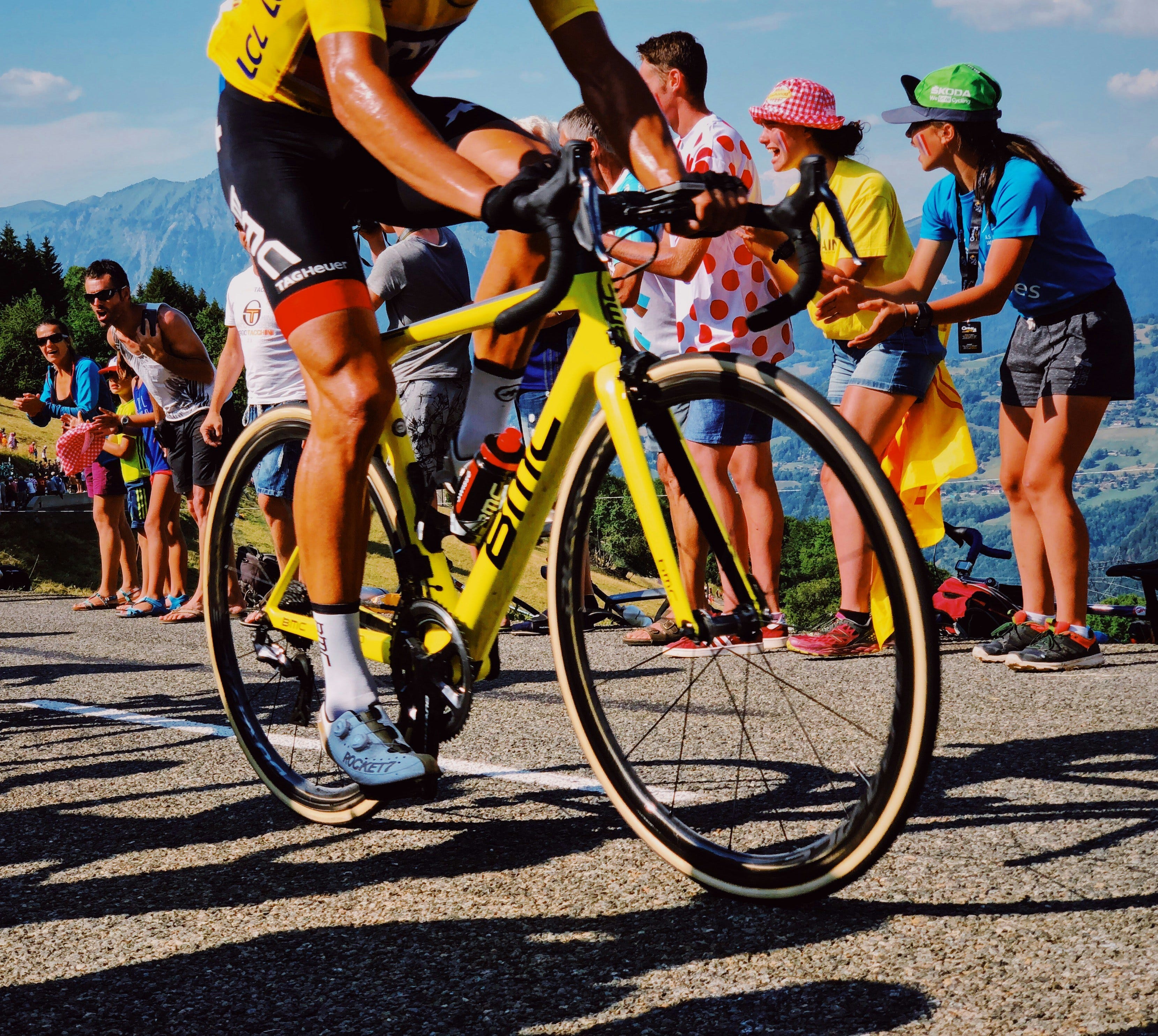
The greatest cycle race in the world completed its 113th edition yesterday in Paris. Even people who do not follow the Tour will be familiar with the iconic and much coveted maillot jaune (yellow jersey), the prize for the cyclist who finishes the three-week race quickest. And yesterday Slovenian Tadej Pogačar wrote his name into the history books by winning his ffith Tour de France to equal the all-time record, wearing yellow from day three all the way to the Champs-Élysées.
But from a mathematician’s point of view, perhaps the most intriguing questions about the Tour have nothing to do with the overall winner and more to do with understanding why riders repeatedly do things that seem irrational. Almost every day a small group of cyclists will attempt to break clear of the peloton despite knowing that they are unlikely to stay away until the finish. Why?
You would be forgiven for thinking that the most important science for understanding bike racing is biology: aerobic capacity, lactate clearance and muscle fibre composition all help determine how much power a rider can produce and for how long. If not biology then surely physics? Cyclists must contend with gravity on the climbs and inertia whenever the pace changes, making the efficient use of energy a constant challenge.
Yet neither of these disciplines fully explains why races play out as they do. Arguably, the clearest lens through which to see the sport is the science of game theory. Game theory has its roots in economics, but can more generally be applied to understanding the interactions of competing individuals. It can suggest optimal strategies for taking penalty kicks, or explain why sometimes it is better for a team to lose than it is for them to win.
When it comes to bike racing, cyclists act in response to the incentives they face. For a select few this might be personal glory, but this doesn’t explain the actions of the vast majority who will never win a grand tour.
Perhaps the most important motivating factor in the modern-day Tour de France has nothing to do with the competitors, the biology or the physics of the sport at all. Marketing is what keeps the Tour’s wheels spinning around. Running a pro cycling team is not cheap, so teams must rely on their sponsors, whose names the teams often carry, for financial support. In return, sponsors expect to have their brand highlighted to the Tour’s global TV audiences at any available opportunity.
The most obvious way to do this is to go after the famous yellow jersey in the competition referred to as the General Classification (GC). But it’s important to remember that there is not just one prize to contend for. There are other jerseys awarded over the course of the race: green for the points classification, red and white polka dot for the King of the Mountains and white for the best young rider. The current leader of each competition heads to the podium after each race, to bask in that hard-earned publicity.
Indeed the Tour de France is not just one race. It is races within races within races. There are also two other daily prizes, more transient in nature than the jerseys, but which also afford a trip to the podium – one for the stage winner and one for ‘combativity’. The combativity award is generally given to the rider who most aggressively attacks the stage. One of the best ways to go about winning this is by getting in a ‘breakaway’.
Naively you might think that the best riders would just get into the breakaway every day and win the race that way, providing non-stop coverage for their sponsors in the process. But that would be to neglect the very significant impact of air resistance. Walking around we barely notice its effect, but at 25 miles per hour, professional cyclists can’t help but feel its drag. Riders at the front of a group bear the brunt of the physical effort of cutting through the air, effectively shielding the riders behind them. Riding in a big group – the peloton - the hard work can be rotated between hundreds of riders. There is an incentive for everyone, even across rival teams, to cooperate because everyone benefits from sharing the aerodynamic burden.
So riders trying to get off the front of the peloton in a breakaway are penalised. A single rider alone would have to do all the work, while even a small team of riders has to do much longer energy-sapping turns on the front (while the others draft behind) than they would in the bunch. Perhaps it is the potential for the individual glory of the stage win that motivates them? But the probability of the breakaway staying out is low. Even if they succeed, only one rider in the group can win, further reducing each individual’s chances. With the odds stacked against them, why do most stages see a small bunch of riders forging out alone? Understanding these seemingly irrational actions is where game theory comes into its own.
The primary motivating factor is the TV coverage afforded to the sponsors of the teams with a rider in the group. This provides the incentive the teams’ directors need to compel their riders to attempt to get in the breakaway. According to game theory, incentives dictate ‘players’ actions.
But despite their best intentions, it is typically within the power of the peloton to pull back any breakaway. Indeed breakaways containing any of the major yellow jersey contenders will typically not be allowed to get away in the first place. The risk is too great for the other GC contenders, so their teams will come to the front of the peloton for a short stint, riding hard to pull them back.
But a group of riders who are not deemed to be a threat for the GC race might be allowed to get ‘up the road’. And for a while they might be allowed to stay there. But if it’s a ‘flat stage’, one in which the big sprinting contenders for the green jersey are interested in winning for themselves, then their teams will come to the front towards the end of the stage, different teams working together to absorb the breakaway back into the pack in the last few kilometres, giving their star performers a chance to battle it out for the win.
Indeed, such is the strength of the incentive for the sprinters’ teams and the importance of air resistance that on flat stages, which suit the heavier more powerful sprinters better than the mountainous stages, only 2% of breakaways stay ahead until the end and win the stage. On the more mountainous stages where air resistance is less important, diminishing the peloton’s advantage, the percentage of successful breakaways rises into the 40s.
Even when a breakaway looks likely to have a big enough advantage to hold off the charging peloton, game theory has one more nasty trick to pull. While the incentive at the start was for all the members of the breakaway to pull together to distance the chasing pack, despite being on different teams, as the end approaches the calculus changes. In a sport where second is the first loser, the overwhelming incentive of the stage victory sees this band of former comrades turn back into competing individuals. People will stop taking turns on the front as they conserve their energy for a sprint finish. Those who do find themselves at the front are forced to constantly look around guarding against attacks from riders (especially those who aren’t the strongest sprinters) thinking of making a break from the breakaway.
While finishing ahead of the chasing pack would be a better result for everyone than being overtaken by the peloton, each rider has a personal incentive to save energy for the finish. The premium on winning over placing high serves to slow the group down to the extent that they can be caught. Everyone loses in what game theorists would call a ‘tragedy of the commons’.
The complexities thrown up by the intricate incentive structures that grand tour cycling offers really can be best understood in light of the maths of games, explaining to some extent why this cerebral and calculating aspect of cycling is referred to as chess on wheels.
A version of this article appeared first on the BBC future website.
Photo by Árni Svanur Daníelsson on Unsplash
Nice article. I really can’t think of another sport where game theory is so prominent, and that’s what I love about watching cycling. I was trying to explain this to my marathon-running colleague. On the face of it, similar sports, but the strategy and tactics of bike racing are unique, and that’s all due to game theory and aerodynamics.
I’d say it’s more like poker than chess on wheels. Often there’s an element of bluffing. The breakaway may slow their pace at times, knowing the peloton is incentivised to allow the break a certain time gap (to discourage more riders bridging across the gap), thus if they play it right, the break can sometimes conserve energy while maintaining a time advantage, increasing their chance of beating the peloton to the line.
Not really convinced by the need to drag in game theory. It's about marketing as you suggest.
If game theory is involved, you need to show your workings.